10 Essential Tips for Choosing the Right Suction Unit for Your Needs?
Choosing the right Suction Unit is crucial for healthcare facilities. Data from the World Health Organization (WHO) highlights that inefficient suction management can lead to increased patient complications. A well-chosen suction unit can improve overall patient safety and streamline clinical workflows.
In recent years, the market for suction devices has grown significantly. According to a report by MarketsandMarkets, the suction unit market is expected to reach USD 1.2 billion by 2025. This growth emphasizes the importance of selecting a unit that meets specific clinical requirements. Many healthcare professionals often overlook the nuances of these devices, leaving gaps in operational effectiveness.
It's essential to understand that no single suction unit is perfect for every situation. Users should reflect on their unique needs, consider factors like portability and power source, and assess various unit capabilities. Choosing wisely ensures a balance between functionality and reliability.

Understanding Different Types of Suction Units Available
Choosing the right suction unit requires understanding the various types that are available. There are primarily three categories: portable, stationary, and wall-mounted suction units. Portable suction units are flexible and can be moved easily. They are suitable for emergency use or home care settings. In contrast, stationary units are designed for hospitals and clinics. They typically offer higher performance and more extensive features.
A report from the National Institute of Health indicates that efficient suction units can significantly lower the risk of infections in medical settings. For example, proper suctioning can clear airways and improve patient outcomes. Wall-mounted units, commonly found in surgical rooms, provide a constant source of suction. Their reliability is essential during procedures where time is critical.
Many facilities sometimes overlook maintenance requirements. Regular checks are necessary to ensure their effectiveness. Units that are not well maintained can lead to increased complications. Each type of suction unit serves its purpose. However, knowing the specific requirements of your environment is crucial. This ensures that you select the most suitable option for your needs.
10 Essential Tips for Choosing the Right Suction Unit for Your Needs
| Feature |
Type A |
Type B |
Type C |
| Power Source |
Electric |
Battery |
Manual |
| Suction Capacity (L/min) |
30 |
20 |
15 |
| Weight (kg) |
5 |
3 |
2 |
| Portability |
Stationary |
Portable |
Hand-held |
| Cost (USD) |
150 |
100 |
50 |
| Noise Level (dB) |
60 |
70 |
75 |
| Maintenance Requirements |
Low |
Medium |
High |
Evaluating the Purpose and Environment for Your Suction Unit
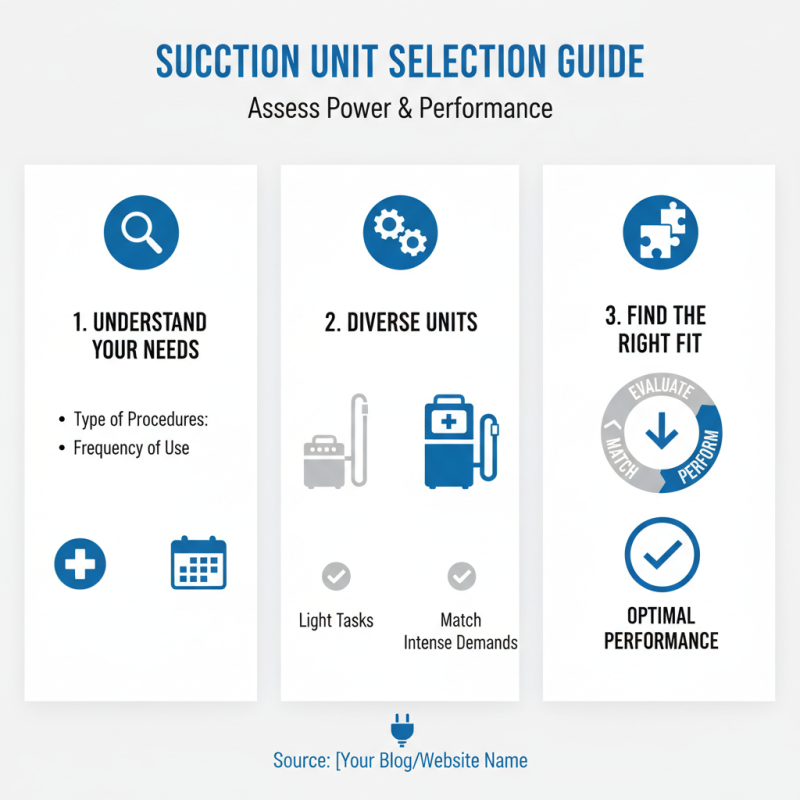
When evaluating your suction unit needs, it’s essential to consider both purpose and environment. Factors like the type of procedures you'll perform make a significant difference. If your work involves surgical settings, portability and reliability are crucial. A suction unit that’s lightweight yet robust can be a game changer.
Different environments demand specific features. For instance, hospital settings may require high-capacity units. Meanwhile, for home care, quieter operation can enhance comfort for patients. Consider where you will primarily use the unit. Will it be in tight spaces or larger rooms? This can affect your choice as well.
Tip: Assess the power source. Electric units may be ideal for hospitals, while battery-operated ones suit mobile environments. Evaluate the risk of spills, especially in emergency situations. Ensure your chosen unit is easy to clean and maintain. It’s not just about functionality; long-term use matters too. An overlooked detail can lead to complications down the line.
Key Features to Look for in a Suction Unit
When selecting a suction unit, understanding its key features is crucial. The suction capacity should match the intended use, which often varies in medical settings. Reports indicate that units with adjustable flow rates significantly enhance usability. Look for models offering at least 20 to 30 liters per minute, suitable for most clinical needs.
Another essential feature is portability. Many units are required to be moved between rooms. Weight and size matter here. Portability can significantly impact efficiency in emergency situations. Ideally, a good suction unit should weigh less than 15 pounds and have a compact design. This way, it allows for quick, hassle-free access.
Battery life can’t be overlooked. A reliable suction unit should operate for a minimum of 1.5 hours on a single charge. Long battery life ensures it will be available when needed, especially in critical scenarios. Furthermore, ease of maintenance can also depict a unit’s reliability. Choose a suction unit that allows for straightforward cleaning and filter replacement to avoid operational inefficiencies.
Investing in a suction unit equipped with these key features not only promotes efficacy but also reflects a commitment to quality care.
Budget Considerations and Cost-Benefit Analysis for Suction Units
When selecting a suction unit, budget considerations play a crucial role. Each suction unit varies in cost, and understanding your financial limits is vital. Evaluate both the initial purchase price and ongoing maintenance expenses. Some units may seem affordable upfront but require costly repairs later. It's essential to balance features with your financial reality.
Conducting a cost-benefit analysis is invaluable. List the features you need versus what you can afford. For instance, a robust suction unit may save you time and effort, but ensure it fits your budget. Reflect on your usage patterns. Will you use it frequently, or only occasionally? Frequent use may justify spending more on a reliable model. Occasionally, a less expensive unit might suffice.
Remember that skimping on quality often leads to greater expense down the line. Investing in a dependable unit can save money on repairs and replacements. Reflect on past purchases. Did you choose based on price alone? Consider how that decision impacted your overall satisfaction. Every choice carries lessons that can guide your future purchases effectively.