Leave Your Message

How to Choose the Best Central Suction Unit?

Choosing the right Central Suction Unit starts with the work it must perform—not the largest motor on a supplier’s list. A dental clinic, a workshop, and a production floor place very different demands on suction. Count the outlets that may run together, note the required airflow and vacuum level, and consider how far air and material must travel. Small details matter: a long pipe run, a clogged filter, or a sudden peak in demand can change system performance.

As central-vacuum engineer Daniel Reed puts it, “A dependable system is sized for real demand, not an impressive number on a brochure.” Treat that as a practical design principle, not a substitute for verified engineering advice. Ask suppliers to explain their assumptions, show expected performance at the point of use, and identify routine service needs. A clear answer is useful. A vague one deserves another question.

Noise, energy use, controls, filtration, and maintenance access also deserve attention. Picture the unit running during a busy shift: Can staff reach the filters safely? Will the equipment room stay ventilated? Can the system handle simultaneous use without losing suction? These are tangible checks, not technical decoration.

There is no perfect unit for every site. Even a careful selection can miss an overlooked operating pattern, so leave room to review actual performance after installation. This guide examines the key specifications, site conditions, and supplier questions that help you choose with confidence—and recognize when the evidence is incomplete.
How to Choose the Best Central Suction Unit?

What a Central Suction Unit Is and Where It Is Used

A central suction unit creates negative pressure at one central plant and distributes it through pipes to multiple workstations. In dental clinics, it draws saliva, water, and debris from treatment chairs. In hospitals, dedicated medical-vacuum systems support clinical suction points. Laboratories and production sites may use separate, application-designed systems for dust or process fluids. The equipment is not interchangeable. Pipe materials, filtration, liquid handling, and backup capacity must match the task.

Quiet, centralized operation helps keep bulky pumps away from treatment rooms. That matters when staff need clear speech and reliable access. ISO 7396-1 sets requirements for medical gas pipeline systems, including medical vacuum. For context, ASHRAE Standard 170-2021 specifies 20 total air changes per hour for operating rooms; this is a ventilation requirement, not a suction-unit rating. Keep that distinction clear. A unit’s real suitability depends on simultaneous demand, pipe length, leakage, and maintenance access. “Central” sounds simple. It can still be poorly sized. Designers should verify peak flow, alarm arrangements, and service records before installation, then check performance under actual use.
How to Determine the Required Suction Capacity

To determine the required suction capacity, list every tool or pickup point connected to the central system. Record each one’s required airflow and operating vacuum from its technical data, then identify which points may run at the same time. Design for realistic peak use, not the sum of every machine’s maximum demand if simultaneous operation is unlikely. But do not assume operators will follow a perfect schedule. That matters.

Capacity is airflow delivered at the required vacuum, not just a free-air rating on a specification sheet. Include pressure losses from pipe length, bends, filters, separators, and the most distant pickup point. A narrow pipe or a clogged filter can leave that point weak, even when the unit appears powerful. Check the expected material load and operating hours, too, since both can affect filter resistance and duty cycle. A neat spreadsheet can still be wrong if actual usage differs.

Use measured demand where possible: observe a typical busy shift and note which points operate together. If measurements are unavailable, document your assumptions and have a qualified system designer verify them. Add capacity for credible future expansion, but avoid oversized equipment; it may waste energy or operate poorly under light demand. Commissioning measurements at remote inlets can reveal issues that calculations miss. Recheck them after the system has settled in.

Which Filtration and Collection Features to Compare

When comparing central suction units, match the filter to the material being collected and the required air quality. Fine, dry dust may need a different filter design from larger chips or damp debris. Check the stated filtration efficiency, filter area, and recommended operating airflow. A high efficiency rating can look impressive, but a clogged filter may reduce suction. No filter is perfect.

Collection features matter just as much. Check the bin’s usable capacity, how it is removed, and whether its seal stays tight during emptying. A small container may need frequent attention in a busy workshop; an oversized one can be awkward to handle. Look for a clear fill indicator or a practical way to check the level without opening the unit. That detail is easy to miss.

Maintenance can reveal whether a system suits daily use. A differential-pressure gauge helps show when a filter needs attention, while automatic cleaning may reduce manual work. Ask how often filters and seals typically need inspection, and whether replacement parts are easy to access. Compare performance at the airflow you actually need, not only at a brochure’s ideal conditions. I would still verify those figures with the supplier; real duct layouts can change the result.

How to Choose the Best Central Suction Unit? – Which Filtration and Collection Features to Compare

Configuration Filtration and collection Often suited to Key advantages Trade-offs and checks What to compare
Cartridge filter with removable bin Pleated cartridge captures dust; collected material drops into a bin. Cleaning may be manual or automatic, depending on the unit. Dry, non-hazardous dust and routine industrial housekeeping, when the selected filter is suitable for the dust. Compact arrangement; cartridge media provides a large filtration area in a relatively small space. Filter loading can reduce airflow. Emptying a bin may create dust exposure; consider a sealed liner or suitable handling procedure. Filter area and media; cleaning method; bin capacity; dust-tight seals; access for filter replacement; airflow monitoring.
Cyclone pre-separator plus final filter A cyclone separates much of the coarse or heavier material by centrifugal action before air reaches a cartridge or other final filter. Dust collects in a bin or drum. Processes with a substantial coarse-particle or bulk-dust load. Can reduce the amount of coarse material reaching the final filter and help extend filter service intervals. A cyclone is not a substitute for a final filter: fine particles can pass through it. Performance depends on particle size, airflow and system design. Pre-separator capacity; final-filter specification; pressure loss; cleanout access; compatibility with the collected material.
Pulse-cleaned cartridge with continuous liner Compressed-air pulses clean the filter; dust falls into a continuous bag or liner that can be sealed and changed with limited direct contact. Frequent collection of dry dust where reducing operator contact during disposal is important. Automatic filter cleaning can support sustained operation; a compatible liner can make dust handling more controlled. Requires suitable compressed air and maintenance. A liner does not by itself make a system suitable for hazardous dust; disposal procedures still matter. Pulse-cleaning settings and air supply; liner type and change procedure; filter-cleaning emissions; bin or liner capacity.
Prefilter plus HEPA final filter A prefilter protects a downstream HEPA filter. Under EN 1822, H13 and H14 filters have efficiencies of at least 99.95% and 99.995%, respectively, at the most penetrating particle size (MPPS), when tested to that standard. Applications requiring high-efficiency final filtration, subject to a dust-risk assessment and the system’s intended use. Provides a defined high-efficiency filter grade when the filter and installed system are appropriately selected and verified. Higher filtration resistance can affect airflow. A filter grade alone does not prove the whole unit is leak-tight; installation, sealing and replacement practices matter. Applicable test standard and filter class; prefilter arrangement; housing seals; leak-test method; pressure drop; safe filter-change procedure.
Wet separator Dust is captured in a liquid-based separation stage, with material retained in a sump or tank. Any required downstream filtration depends on the design and application. Selected dusts for which wet collection is specifically assessed as appropriate. Can capture material through liquid contact rather than relying solely on dry filter media. Not suitable for every dust. Some materials react with water or create other hazards; consider corrosion, liquid handling and waste disposal. Dust and liquid compatibility; separation efficiency; sump capacity; mist control; corrosion resistance; cleaning and wastewater arrangements.

Selection note: These are general configuration comparisons, not guaranteed performance specifications. Confirm the dust’s properties and hazards, required capture airflow, pressure losses across the system, filter test documentation, collection and disposal method, and applicable local requirements with a qualified system designer.

How to Assess Installation Needs and System Compatibility

Before selecting a central suction unit, map the spaces it must serve. Measure the longest pipe runs, count bends, and note where branches join. A sharp turn can add resistance. So can a clogged filter.

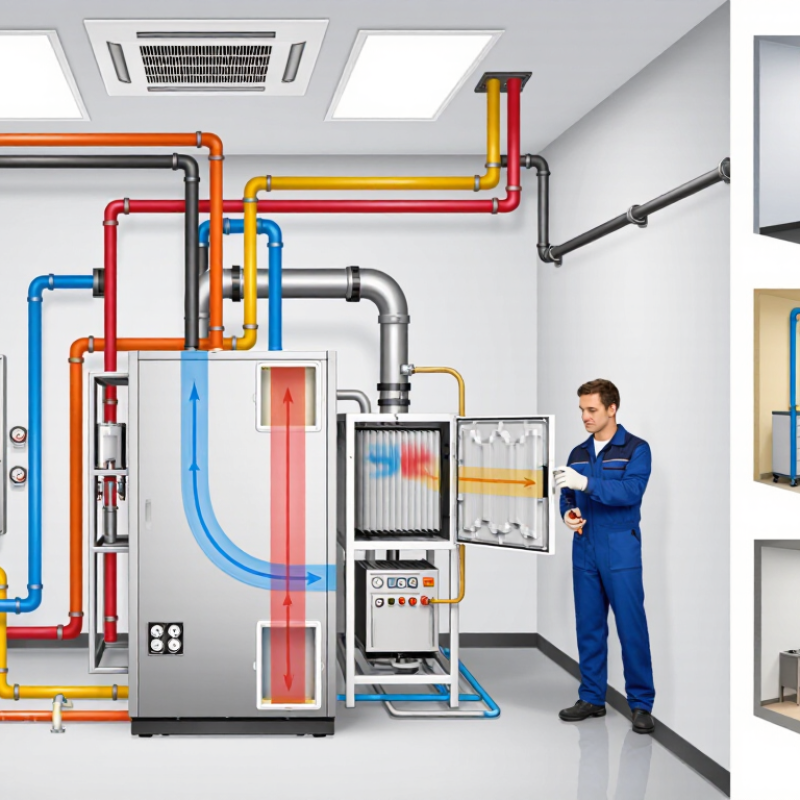
Walk the proposed route with an installer, not just a floor plan. Check ceiling voids, wall thickness, drain access, and room for maintenance. Leave enough clearance to remove the motor or filter. Tight cupboards look tidy, but they can make routine service awkward. That detail is easy to miss.

Then compare the unit’s airflow and pressure requirements with the pipe network and pickup points. Ask whether simultaneous use is expected, and how often. Existing ductwork may fit, but its diameter, joints, and condition still need inspection. Do not assume compatibility from appearance alone. Verify electrical supply, ventilation, and noise limits at the planned location. A garage installation, for example, may need different sound control from a utility room beside a bedroom. Record these checks before requesting a specification. I would not treat a single measurement as proof; site conditions change, and drawings can be wrong. A small uncertainty is worth resolving before pipes are concealed.

How to Compare Maintenance, Safety, and Operating Costs

A central suction unit should be compared by its full service cost, not purchase price alone. Include electricity, filters, scheduled inspections, repairs, and downtime in a five-year estimate. The U.S. Department of Energy’s Improving Pumping System Performance: A Sourcebook for Industry reports that pumping systems can use 25–50% of the energy in some industrial facilities. That range is not a prediction for one suction unit, but it shows why measured power and operating hours matter. Ask suppliers for power consumption at your actual airflow and pressure, not just rated capacity. Small details count.

For maintenance, compare filter replacement intervals, access to service points, and the cost of common wear parts. A filter hidden behind pipework can turn a quick task into a longer shutdown. Check noise levels, exhaust routing, heat, and how safely technicians can isolate the unit before servicing. Keep service records; they reveal rising energy use or pressure loss before a breakdown. I would treat projected savings cautiously. Real workloads fluctuate, and a neat spreadsheet can miss them. Compare warranty coverage and technician response times alongside energy figures, then verify the assumptions against your site’s operating logs.

How to Choose the Best Central Suction Unit?

Compare maintenance, safety, and estimated annual operating costs.

How to read this: These planning estimates assume 4,000 operating hours per year, electricity at $0.12/kWh, and maintenance labor at $60/hour. Actual costs vary with system sizing, duty cycle, energy rates, and service requirements. Purchase price, parts, filters, and demand charges are excluded. Safety is not represented as a cost score: confirm appropriate vacuum relief, electrical protection and grounding, guarding, and safe filter handling against the system design and applicable local requirements.